
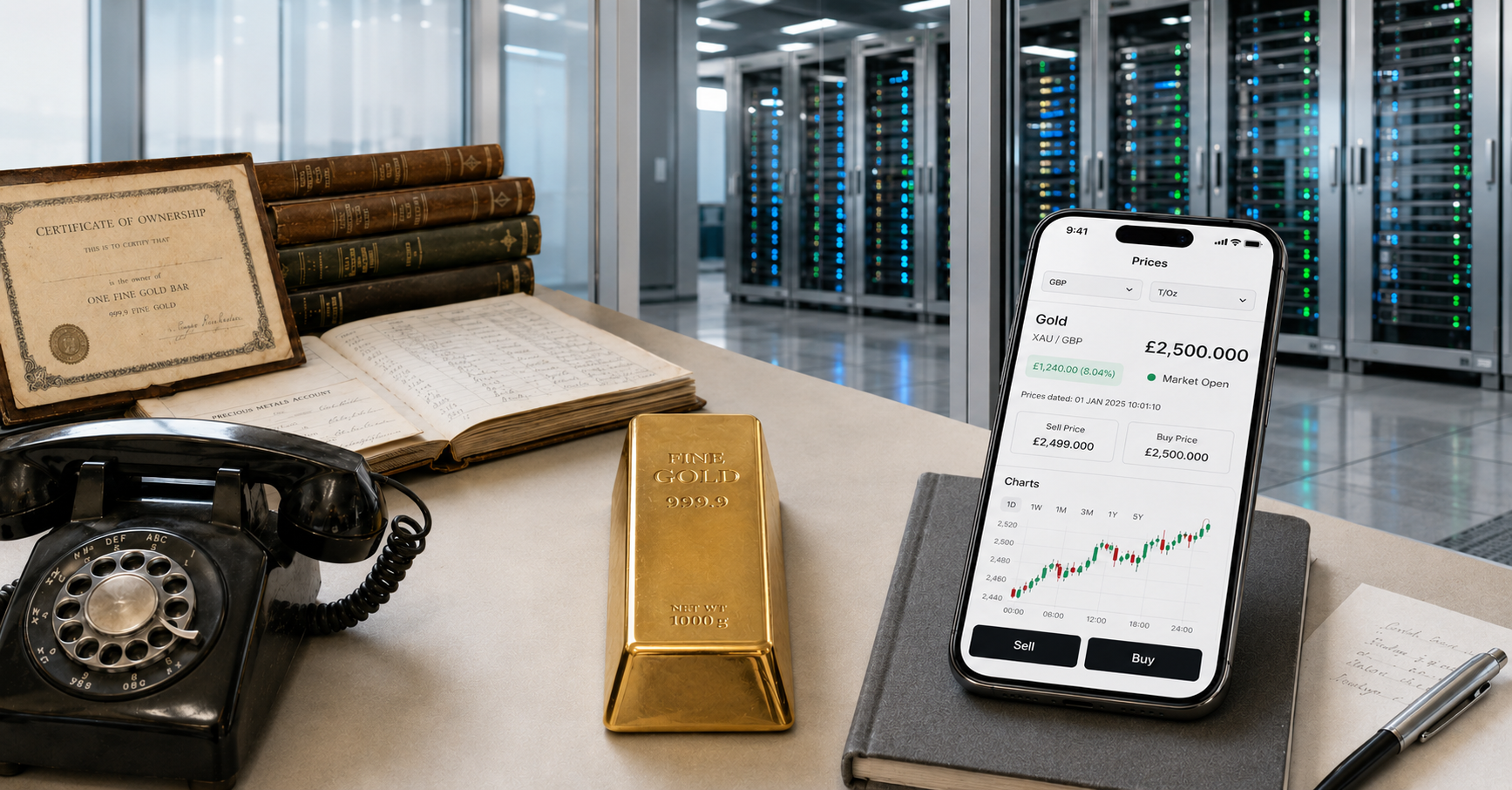

Technology has transformed the way we buy, store and trade gold. Ownership remains the part investors value most.
For most of financial history, buying gold required almost as much trust as buying a house.
An investor telephoned a broker, accepted whatever price was available, signed paperwork that arrived days later and waited. Settlement drifted along at the pace of postal services, banking systems and administration. By the time ownership was confirmed, the market had often moved several times.
Nobody found this unusual because there was nothing to compare it with. Markets moved slowly because the world moved slowly.
Looking back, what stands out is not the inefficiency. It is the uncertainty. Gold was bought because it represented permanence, yet acquiring it relied on a chain of intermediaries that few investors ever saw. The transaction finished only when everyone else had done their part.
Those frictions disappeared slowly, then all at once.
Telephone dealing became online execution. Paper certificates disappeared behind digital account statements. Live pricing replaced yesterday’s quotes. Investors stopped measuring settlement in weeks and started measuring it in minutes.
The mechanics changed beyond recognition.
The reason for buying gold barely changed at all.
People were still looking for ownership of an asset that existed independently of somebody else’s balance sheet.

Ownership Became Easier
Exchange traded funds attempted to bridge the emerging world of electronic markets with an asset that remained stubbornly physical. They made exposure to gold as easy to buy and sell as any listed security and, for many investors, that was enough.
But exposure and ownership were never quite the same thing. An ETF could track the economics of gold extremely efficiently; it could not turn a financial claim into a bar of bullion owned directly by the investor. For those who bought gold precisely because they wanted an asset outside somebody else’s balance sheet, that distinction mattered. Bullion dealers recognised it long before fintech became fashionable.
Rather than competing with ETFs, they borrowed their convenience. Live pricing replaced telephone quotes. Digital platforms replaced paper forms. Professional vaulting removed much of the practical burden that had discouraged private ownership for decades.
Small bars and coins carried high manufacturing costs and dealer premiums, leaving smaller investors at a disadvantage. Fractional ownership of larger institutional bars solved that problem. Instead of manufacturing ever smaller pieces of bullion and charging investors accordingly, a large bar could remain intact inside a professional vault while its ownership was divided between investors.
That allowed somebody investing a modest amount to access the economics of larger-format bullion rather than the premiums attached to a tiny physical bar. Equity markets had already normalised fractional investing. Gold simply adopted the same idea without changing the asset itself. The innovation happened around the metal, not inside it.
Platforms such as Goldwise illustrate that shift.

Source: www.goldwise.com
Goldwise is not trying to reinvent gold. It is removing the historic inconveniences attached to owning it, making it easy, secure and efficient to trade no matter the person. Investors can build positions gradually and access institutional pricing which is usually inaccessible to retail investors. Investors can manage holdings digitally and retain ownership of physical precious metals without paying the premiums traditionally associated with buying small bars and coins.

Source: Oliver Market Intelligence
Who Actually Needs Tokenisation?
Which raises an awkward question about what is routinely presented as the industry’s next great innovation.
If investors can already buy fractional physical gold, manage it digitally and retain ownership of the underlying metal, what exactly is left for tokenisation to solve?
Viewed through institutional eyes, the problem looks completely different.
Someone building long-term wealth can already buy fractional physical gold, manage it digitally and own professionally vaulted bullion. If the ownership experience already feels identical, the burden shifts. The token has to explain why it exists.
A bullion bank settling hundreds of millions of pounds worth of metal is not thinking about monthly savings plans or fractional ownership. It is thinking about settlement risk, reconciliation and the movement of cash and assets across multiple systems.
That is the plumbing of markets, not the business of investing.
Every generation believes it has finally solved settlement. Markets become faster. Settlement becomes cleaner. Friction disappears.
For decades the industry’s problems were obvious: buying was cumbersome, settlement was slow and smaller investors paid disproportionately high costs. Those frictions have largely disappeared.
Instead of improving access to gold, it proposes improving the movement of ownership itself.
Move that ownership record from a conventional ledger onto a blockchain and the daily experience barely changes. In some structures, the investor may simply have exchanged one intermediary for another.
That matters because tokenisation can introduce counterparty risk of its own. If tokens are not fully backed at the point they are issued, or the underlying metal is acquired only after investor money arrives, the technology has not eliminated dependency. It has simply moved it somewhere less visible.
At that point, it is worth asking whether financial innovation is solving another investor problem or simply adding another layer to an ownership model that already works.
Gold still needs to be refined, transported, insured and stored. Someone still has to verify that it exists and reconcile ownership with the bullion sitting inside the vault.
Gold has always attracted investors looking for fewer dependencies, not more. Every additional layer deserves to justify its existence.
Physical gold remains roughly fourteen times larger than the ETF market. For all the financial innovation surrounding precious metals, most investors still choose to own the asset rather than another claim on it.

Source: Oliver Market Intelligence, World Gold Council
The Institutional Case
The strongest argument for tokenisation does not come from retail investing, it comes from wholesale markets.
The London bullion market already moves enormous quantities of gold every day without trucks shuttling bars from one vault to another. Ownership changes largely through book entries between institutions. Cash settles through one system, bullion through another. Those separate processes require constant reconciliation and leave counterparties briefly exposed while each side completes its obligations.
If ownership of bullion and payment for bullion could settle simultaneously on shared digital infrastructure, much of that operational risk begins to disappear. Institutions no longer wait for one side of the transaction to catch up with the other. Settlement becomes synchronised rather than sequential. The same argument applies to stablecoins. Pair tokenised cash with tokenised bullion and wholesale settlement becomes cleaner, faster and carries less counterparty risk. That is a far stronger use case than asking a long-term investor to hold another digital representation of physical gold.
There is another question institutions cannot avoid: who is standing behind the token?
Putting ownership onto a blockchain does not make the underlying gold appear. Someone still has to hold the bullion, verify it, allocate it correctly and ensure that the tokens in circulation correspond to metal that actually exists. A token backed one-for-one by identifiable bullion held with credible custodians is a very different proposition from an instrument backed by a contractual promise, pooled assets or metal acquired after the claim has already been created.
Tokenisation can reduce settlement risk. It cannot make backing risk disappear.
Regulators appear to be reaching a similar conclusion. The Financial Times reported in August that the Financial Conduct Authority had been discussing a framework for tokenised gold, including its potential use as collateral in wholesale markets. The significance is not that regulators have suddenly discovered a better way for somebody to save £100 a month into gold. It is that digitised bullion could become useful infrastructure for institutions moving collateral, cash and ownership through financial markets.
That distinction matters. Tokenised gold may prove extremely useful without becoming particularly important to the ordinary gold investor.
Tokenisation looks less like an investment product and more like plumbing.
Someone allocating part of their monthly income to gold is rarely trying to build programmable collateral or move assets between blockchain networks. They want secure ownership, sensible costs and confidence that the metal will still be there years from now.
Goldwise has spent the last few years closing that gap.
Rather than creating another representation of gold, the platform removes many of the practical obstacles that once discouraged ownership altogether. Fractional investing allows people to build positions gradually. Institutional pricing narrows the gap between retail and wholesale markets. Professional vaulting removes the burden of private storage while preserving ownership of physical precious metals.
None of this suggests tokenised gold lacks a future. It almost certainly has one. But its natural home may prove to be institutional settlement rather than retail investing.
For many long-term precious metals investors, those capabilities solve problems they were never trying to solve.
Infrastructure Changes Faster Than Investors
AI is unlikely to care whether gold is tokenised. It will care whether ownership settles automatically. Human investors tolerate friction because they trade occasionally. Machines will not. As AI shifts from supporting investment decisions to making them, settlement stops being a convenience and becomes part of the investment process itself.
Institutions may need that long before investors ever do.
There is a broader shift taking place underneath all of this. Financial platforms were once largely self-contained. If a company wanted to offer banking, payments or investment products, much of the underlying infrastructure had to be built or assembled itself. APIs changed that model.
Banking-as-a-Service showed what happened next. Fintechs and challenger banks could plug into infrastructure provided by somebody else and offer increasingly sophisticated financial products without becoming banks themselves. Investing has followed much the same path. Brokerage infrastructure, execution and liquidity can increasingly be accessed through APIs, allowing platforms to build investment propositions without recreating the machinery underneath them.
Precious metals have been slower to fit that model. Equities are already digital assets operationally; physical gold is not. It still has to be sourced, allocated, vaulted, insured and ultimately settled.
That makes precious metals infrastructure more interesting than another front-end investment product. Goldwise’s Precious Metals as-a-Service model effectively puts that physical machinery behind an API, allowing financial platforms to offer physical precious metals alongside other asset classes without having to build custody and settlement infrastructure themselves.
AI could accelerate the significance of that. An AI investment system comparing forms of gold exposure may have little reason to prefer an additional financial claim where direct physical ownership is available on comparable terms. As investing becomes increasingly automated, the valuable technology may therefore sit behind the asset rather than replace it: infrastructure that allows machines to buy, settle and hold physical gold as easily as they already can a digital security.

Source: www.goldwise.com
Telephone brokers disappeared. Paper certificates disappeared. Settlement cycles shortened. Fractional ownership opened a market that once demanded substantial capital.
Each development made ownership easier without changing what investors were buying.
Tokenisation may yet become indispensable for wholesale settlement, institutional infrastructure and digitally native capital markets. Those use cases are persuasive because they address genuine operational problems.
Does the technology bring them closer to the metal, or merely place another system between them and it?
Half a century ago investors waited weeks for a letter confirming they finally owned their gold.
Today they expect that certainty almost instantly.
Technology has transformed almost every part of owning gold. The one thing investors continue demanding is ownership itself.
If you are considering owning physical precious metals, including gold, silver, platinum or palladium, you can explore your options through www.goldwise.com — where the focus is on ownership, security and transparency.
We are continuing to build Goldwise with content that helps investors understand what is really happening beneath the surface. If there are specific topics you would like us to break down further, or areas you feel are not being covered clearly enough, let us know.
This content is provided for informational purposes only and does not constitute financial advice or a recommendation to buy or sell any investment. The value of precious metals can fall as well as rise, and you may get back less than you invest. Past performance is not a reliable indicator of future results. You should conduct your own research and, where appropriate, seek advice from a qualified financial adviser.