

From inflation and government debt to currencies, geopolitics and investor demand, gold’s price is shaped by competing forces. But what happens when they pull in different directions?
On 30 October 2026, gold suffered an unusually sharp 3.5% single-day fall, dropping below $4,000 to approximately $3,881 an ounce. Silver fell 6.5%, slipping beneath $50.
Both had retreated dramatically from January’s record highs. Gold was down approximately 30% from nearly $5,600, while silver had lost almost 60% from above $120.
Yet the world was hardly becoming more stable. Wars in Ukraine and the Middle East continued, inflation remained a concern and governments kept accumulating debt.
The UK’s latest Budget forecast another £133.2 billion of borrowing in 2026/27, adding to a national debt exceeding £3 trillion. Across the Atlantic, US national debt had surpassed $40.5 trillion.
Meanwhile, central banks continued accumulating gold, purchasing 321 tonnes in Q3, up 42% year-on-year.
These were precisely the conditions in which many investors would expect gold to rise.
Instead, it fell.
Then, on 4 November, gold rebounded 3.4%, climbing back above $4,000, while silver gained 4.9%.
The wars hadn’t ended. Government debts hadn’t disappeared. So what had changed?
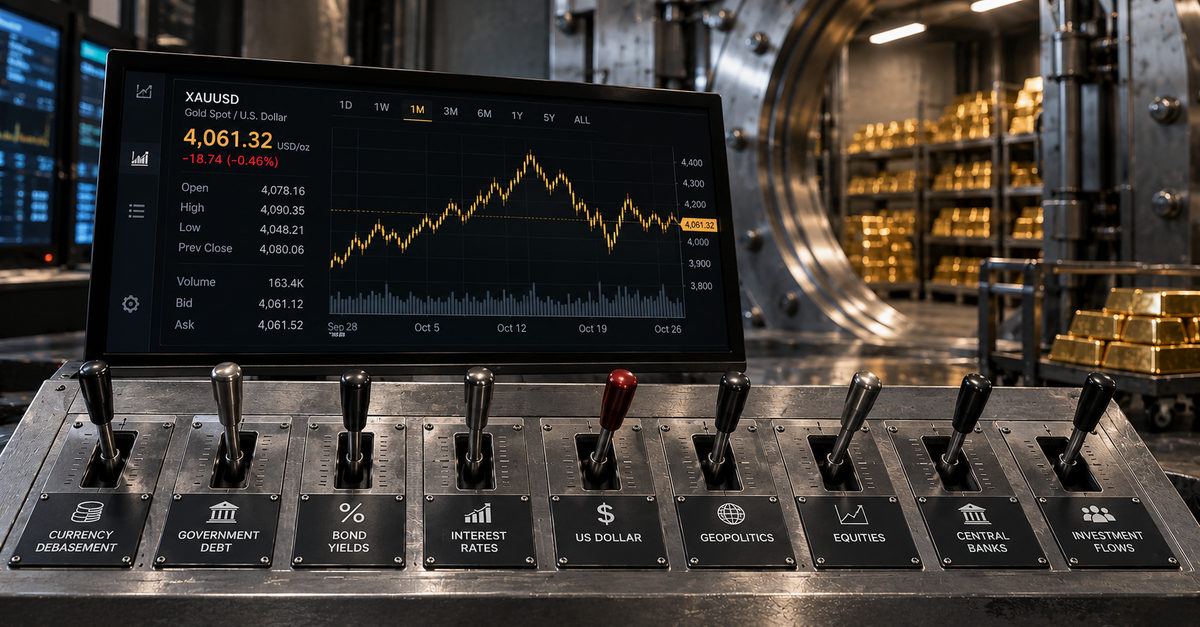
Think of the gold market as a control panel, with different economic forces operating as levers. Some push prices higher, others lower. Some influence markets over decades; others can dominate within hours.
Gold’s price reflects the combined influence of these levers, not the direction of any single one.
The Levers Behind the Price
Gold’s price is influenced by numerous interconnected economic, political and market forces. Each can push prices higher or lower, and their influence changes depending on market conditions. Some of the main levers include:
💸 Currency debasement and inflation — Gold’s supply grows slowly compared with currencies, making it attractive when purchasing power is being eroded.
Typically: Weaker purchasing power → Stronger gold demand.
🏛️ Government debt and fiscal deficits — Rising borrowing and concerns about sovereign finances can encourage investors to diversify away from government-issued assets.
Typically: Greater fiscal concerns → Stronger gold demand.
📈 Interest rates and bond yields — Gold pays no interest, so higher inflation-adjusted (real) bond yields generally make interest-bearing assets more attractive. But why yields rise matters: if investors lose confidence in government finances and demand higher bond returns, that same concern can increase demand for gold.
Typically: Higher real yields → Lower gold prices. Falling bond confidence can push both yields and gold higher.
💵 The US dollar — Gold is internationally priced in dollars. A stronger dollar generally makes it more expensive for buyers using other currencies.
Typically: Stronger dollar → Lower dollar-denominated gold prices.
🌍 Geopolitics and equity markets — Wars and uncertainty can encourage safe-haven buying. Severe stock-market declines, however, may force investors to sell gold to raise cash.
Typically: Greater geopolitical risk → Stronger demand, unless liquidity pressures trigger selling.
🏦 Central banks and investment flows — Central banks may accumulate reserves over decades, while investment funds and leveraged traders can change positions within minutes.
Typically: Stronger net buying → Greater price support, unless selling elsewhere outweighs it.
Each lever matters. But the outcome isn’t always the same.
When One Lever Pulls Another
Consider what happens when conflict disrupts global oil supplies.
Geopolitical uncertainty may increase demand for gold. But higher oil prices also fuel inflation, potentially delaying interest-rate cuts, increasing bond yields and strengthening the dollar.
Some investors might redirect capital from gold into oil to speculate on higher energy prices, although the scale of such switching is difficult to establish.
Others may have little choice. Falling markets can trigger margin calls, forcing leveraged investors to sell liquid assets, including gold, to raise cash.
One event has activated several levers, pulling the price in opposite directions.
The same crisis can create reasons to buy gold and reasons to sell it.
Markets also respond to expectations, not simply current conditions. A war may continue, but signs of a ceasefire can reduce demand for protection. Inflation may remain high, but changing interest-rate expectations can alter gold’s appeal.
Sometimes, circumstances barely change. The market’s interpretation does.
The Same Levers, Different Outcomes
History shows why these relationships aren’t fixed.
In 2013, gold fell almost 30% as real yields rose, US monetary-policy expectations changed and investment demand weakened.
In 2022, US real yields increased by approximately 250 basis points and the dollar strengthened by more than 8%. Yet gold finished the year 0.4% higher.
Why? The war in Ukraine, inflation concerns and strong physical demand counterbalanced the pressure from interest rates. Central banks also bought a record 1,136 tonnes.
The World Gold Council highlighted these competing forces. The relationship between gold and yields hadn’t disappeared. Other levers had become more influential.
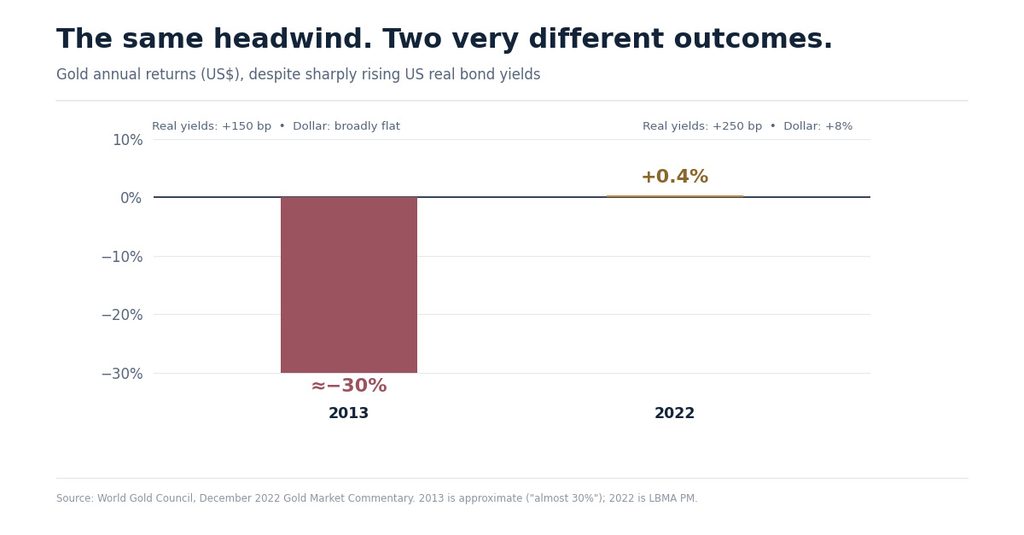
Gold returns amid rising US real yields: 2013 versus 2022. Source: World Gold Council, December 2022.
Selling What You Can, Not What You Want
Gold’s liquidity can work against its price during financial stress. When investment funds face losses, margin calls or withdrawals, they may sell gold simply because it can be converted into cash quickly, not because their longer-term view has changed.
During the 30 October sell-off, technology shares declined amid concerns about AI investment returns. Gold fell 3.5%, despite falling US Treasury yields that might ordinarily have supported its price.
Forced liquidation and changing interest-rate expectations appeared to outweigh that support. The World Gold Council’s early November analysis identified reductions in futures positioning of around 11 tonnes from managed-money positions and 70 tonnes across other futures categories since mid-October.
Central banks and physical investors may hold gold for years, while leveraged traders sell to meet immediate obligations. Falling prices can then trigger further liquidation, reinforcing the move.
When Big Buyers Can’t Stop the Price Falling
Central banks offer perhaps the clearest example of competing levers. According to the World Gold Council, they purchased 321 tonnes in Q3 2026, up 42% year-on-year.
In September alone, disclosed purchases reached 61 tonnes, the highest monthly total of the year. Yet gold fell 8.5% that month.
Central banks represent only one source of demand. Rising Treasury yields, dollar strength and speculative selling can overwhelm strategic purchases in the short term. Managed-money futures positioning fell by approximately 84 tonnes during September.
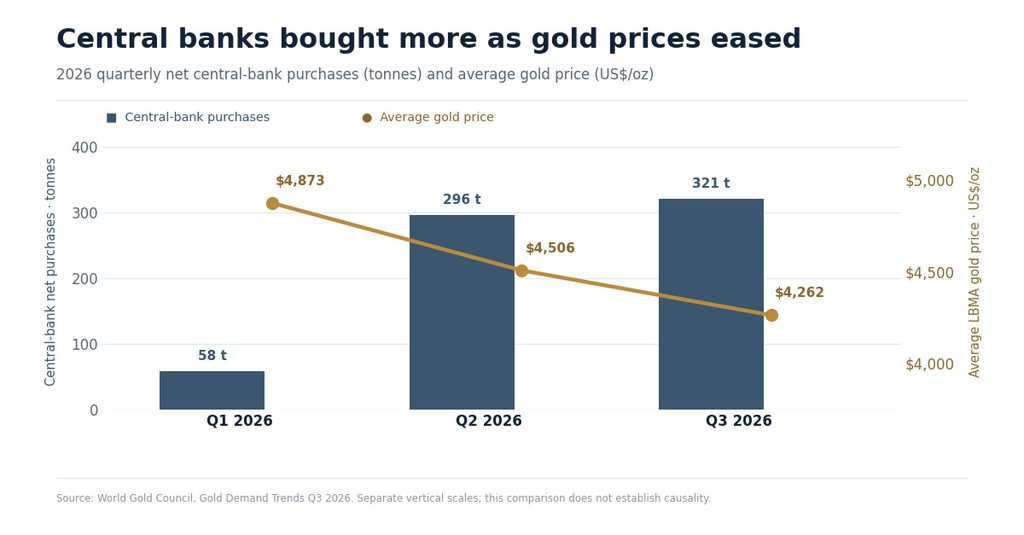
Central-bank purchases versus the quarterly average gold price, Q1–Q3 2026. Source: World Gold Council. Different vertical scales; this comparison does not establish causality.
This also exposes a weakness in how gold demand is sometimes reported. ETF inflows and outflows feature heavily in commentary, but they represent only one part of the gold market.
Physically backed ETFs account for approximately 2% of above-ground gold. Physical bars, coins and OTC holdings collectively represent roughly 14 times the gold held by these funds. These figures compare existing holdings, not trading flows: ETFs may still influence short-term pricing, but their flows should not be treated as a measure of total gold demand.
In Q3, central banks purchased 321 tonnes, physical bar-and-coin investment totalled 268 tonnes, and ETFs recorded 211 tonnes of inflows. Jewellery fabrication, technology and OTC activity also contributed to overall demand.
Demand wasn’t uniformly strong: physical bar-and-coin investment was 19% lower year-on-year. Different investors were responding to different pressures.
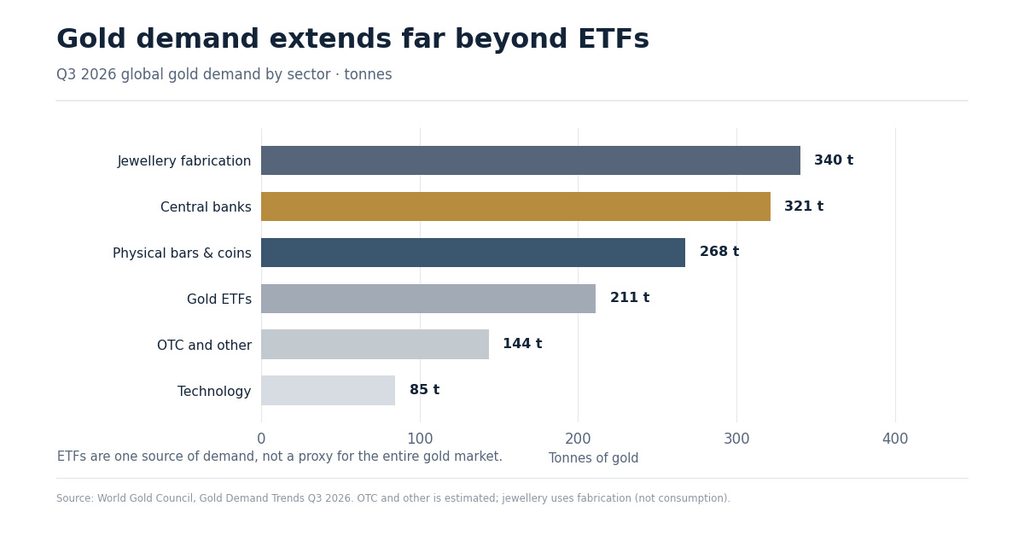
Global gold demand by sector, Q3 2026. Source: World Gold Council. ETF flows are one component, not the whole market.
Gold’s price reflects the balance of buyers and sellers, not a unanimous view of the economy.
When the Levers Create an Opportunity
When several levers move together, they can produce sharp corrections. Higher interest-rate expectations, a stronger dollar, speculative selling and forced liquidation can push gold lower, even while longer-term drivers remain intact.
Government debt may still be increasing. Currency concerns may remain unresolved. Central banks may continue accumulating reserves.
When short-term selling pressures outweigh longer-term drivers, corrections can create attractive entry points for investors looking to own gold.
The distinction is between a change in price and a change in the reasons for owning the asset. For someone considering physical gold for diversification or long-term wealth preservation, a correction may offer a better entry price than buying after a sustained rally.
Prices can still fall further, and identifying the bottom is difficult. Building a position gradually can reduce reliance on a single entry point. Silver can experience similar opportunities, but its industrial exposure and greater volatility can amplify price movements.
Sometimes, the same forces creating uncertainty can also create opportunity.
Gold Isn’t Breaking the Rules
Gold can rise during inflation and fall during inflation. It can rally amid geopolitical uncertainty or decline as investors seek cash. Even substantial central bank buying can coincide with falling prices.
These aren’t necessarily contradictions. They reflect different forces operating over different timescales.
Sometimes gold falls not because the reasons to own it have disappeared, but because the immediate reasons to sell it have become stronger.
Gold doesn’t have one rule to follow. It has many forces to respond to. Understanding how those levers interact is more valuable than trying to predict which way gold will move next.
If you are considering owning physical precious metals, including gold, silver, platinum or palladium, you can explore your options through www.goldwise.com — where the focus is on ownership, security and transparency.
We are continuing to build Goldwise with content that helps investors understand what is really happening beneath the surface. If there are specific topics you would like us to break down further, or areas you feel are not being covered clearly enough, let us know.
This content is provided for informational purposes only and does not constitute financial advice or a recommendation to buy or sell any investment. The value of precious metals can fall as well as rise, and you may get back less than you invest. Past performance is not a reliable indicator of future results. You should conduct your own research and, where appropriate, seek advice from a qualified financial adviser.