


From billion-dollar cyber thefts to infrastructure failures, could digital disruption become the next major threat to financial stability?
On 29 October 2026, hackers stole approximately $6.3 billion in digital assets from Binance, the world’s largest cryptocurrency exchange.
But perhaps the most extraordinary detail wasn’t the amount.
The main wave of theft took just 20 minutes.
In many respects, the operation wasn’t so different from the great bank robberies of the past. The attackers studied their target, identified weaknesses in its security and carefully planned their operation before gaining access and transferring the stolen assets.
The route into Binance’s systems was strikingly human. According to its investigation, a DevOps engineer downloaded a tampered installer for an AI coding tool, while another engineer was deceived by a fraudulent recruitment process into downloading malicious software onto a work computer.
Those entry points helped attackers compromise internal systems and reach the infrastructure used to authorise transactions. Even a carefully designed and tested security system can be undermined when someone trusts the wrong person or downloads the wrong software.
What has changed is the physical constraint.
Imagine stealing $6.3 billion in cash or gold bars. The weight, security, manpower and logistics involved in removing and transporting that amount would present extraordinary obstacles.
Yet digital assets can be transferred across international borders in minutes, by attackers operating remotely.
And here’s the contradiction. Blockchain transactions can often be traced. Investigators can follow the wallets, and the FBI has attributed the Binance attack to North Korean hackers.
But knowing where the money went isn’t the same as being able to get it back.
By 18 November, Binance had reported approximately $2.85 billion in stolen assets frozen or intercepted and secured an Abu Dhabi court order supporting recovery efforts. It also committed its own substantial resources to replenishing customer holdings.
But what happens to an exchange without those resources? And what if another attack succeeds tomorrow?
The New Age of Cybercrime
Cybercrime has evolved far beyond individuals stealing passwords. Today’s threats include organised criminal networks and state-backed groups with considerable technological and financial resources.
Artificial intelligence is accelerating that evolution.
AI can help identify vulnerabilities, develop malicious software and create convincing social-engineering campaigns. Activities once requiring significant expertise and time can increasingly be automated.
CrowdStrike’s 2026 Global Threat Report found that attacks by AI-enabled adversaries increased 89% during 2025. Its average criminal breakout time — the period between initial compromise and movement into another system — fell from 98 minutes in 2021 to just 29 minutes in 2025.
The fastest observed breakout took only 27 seconds.
These figures don’t mean every cyberattack is AI-driven, but they illustrate how quickly the threat is evolving. The UK’s National Cyber Security Centre has warned that AI is increasing the speed and scale of cyber operations, including those linked to foreign governments.
How do financial institutions defend themselves when attackers can operate at such speed, potentially with the backing of an entire state?
TRM Labs recorded 207 crypto hacks in H1 2026, compared with 83 a year earlier — a 149% increase in reported incidents. The figures show how frequently digital-asset platforms and protocols are being targeted.
Figure 1 | Recorded crypto hacks increased 149%
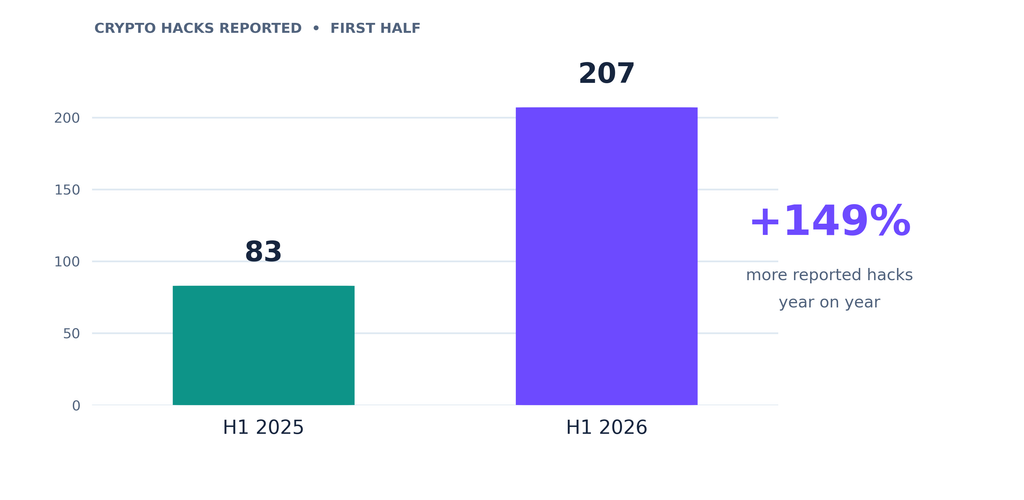
Source: TRM Labs, H1 2026 Crypto Hacks Report (July 2026). Recorded incidents: 83 (H1 2025) and 207 (H1 2026). Recreated from published data. Original TRM Labs research and charts
When the Digital World Stops Working
The risks extend far beyond stolen financial assets.
On 12 November, Microsoft experienced a major outage affecting Outlook, Teams and other Microsoft 365 services, disrupting businesses and public services. Just weeks earlier, a Google Cloud outage affected UK banking services.
Neither incident was reported as a cyberattack. But both exposed our growing dependence on a relatively small number of technology providers.
You can have money in your bank account but be unable to spend it, or own investments but temporarily lose access to your trading platform.
Research published by the Post Office on 12 November found that 24% of surveyed UK retailers had experienced payment disruptions severe enough to turn customers away, delay transactions or close. Yet 90% didn’t include accepting cash in their contingency plans.
In October, Defence Secretary Wes Streeting highlighted the threat of cyberattacks disrupting essential supplies, while the government’s Be Ready campaign encouraged households to maintain three days of emergency provisions.
If ordinary technical failures can cause widespread disruption, the consequences of coordinated attacks against critical infrastructure deserve serious consideration.
The Tokenisation of Everything
Meanwhile, financial markets are moving towards an increasingly digital future.
Cryptocurrencies enable international transfers within minutes. Stablecoins aim to maintain their value against conventional currencies, while tokenisation promises faster settlement and broader access to securities, bonds and physical commodities.
The benefits are considerable, but the risks differ.
Cryptocurrencies depend on network security and private keys. Stablecoins introduce issuer, reserve and redemption risks. Tokenised investments depend on the legal rights and custody arrangements supporting their underlying assets.
Where assets are held also matters.
Exchanges typically maintain cryptocurrency in internet-connected hot wallets to facilitate transactions. Even brief periods of online custody can create exposure if transaction-authorisation systems are compromised.
Cold storage reduces remote-access risk by keeping private keys offline, but introduces challenges around transactions, access and recovery.
The Binance incident also demonstrated the unusual characteristics of stablecoins. Some issuers helped freeze stolen assets, providing a means of limiting losses, but also demonstrating that control over digital money can depend on third parties.
The very features that make digital assets attractive — speed, accessibility and transferability — can also create opportunities for attackers.
Protecting Digital Wealth
Figure 2 | A small group of compromises drives most losses
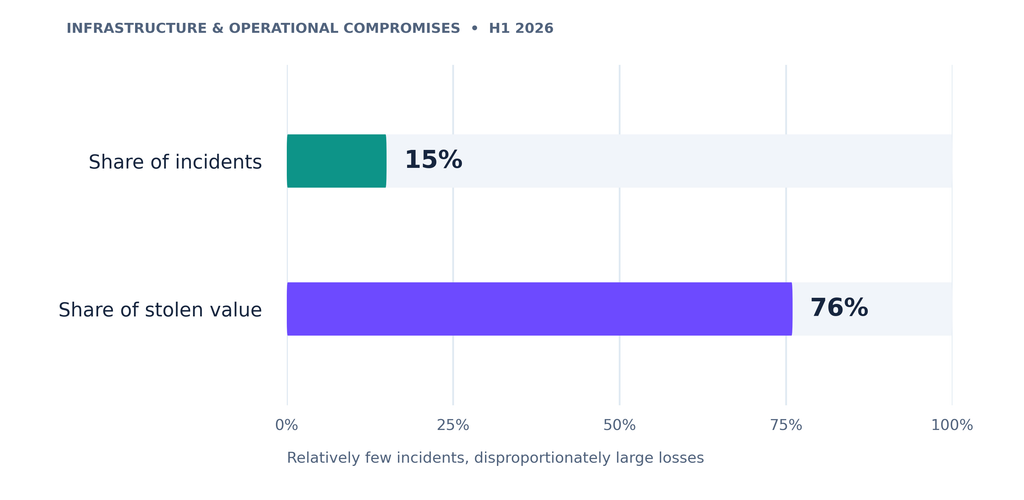
Source: TRM Labs, H1 2026 Crypto Hacks Report (July 2026). Infrastructure and operational compromises: about 15% of incidents and 76% of stolen value. Recreated from published data. Original TRM Labs research and charts
The priority for financial platforms is increasingly to prevent, contain and recover from attacks.
Verizon’s 2026 Data Breach Investigations Report found that 31% of breaches began with exploitation of software vulnerabilities, up from 20% in its previous report, overtaking stolen credentials as the leading initial entry method. Third parties were involved in 48% of breaches.
Microsoft’s 2026 Digital Defense Report adds another warning: in its incident-response investigations, phishing as an initial access method rose from 7% to 23%, while exploitation of public-facing applications increased from 15% to 24%.
More tellingly, TRM Labs found that infrastructure and operational compromise accounted for only around 15% of crypto hacks in H1 2026 but approximately 76% of money stolen: a stark indication of the exposure created when signing authority or custody systems fail.
The implications are clear: security depends not just on protecting an organisation’s systems, but on managing suppliers, access controls and recovery capabilities.
For digital-asset platforms, offline custody, independent transaction authorisation, withdrawal limits and continuous monitoring can reduce exposure.
But protecting ownership records is equally important.
Cyberattacks can also compromise the internal records showing who owns what. While public blockchains preserve transaction histories, many exchanges hold customer assets in shared wallets, relying on their own ledgers to record individual ownership.
If those records were corrupted or destroyed, reconstructing customer holdings could become extremely difficult without independently protected backups and reliable reconciliation systems.
For investors, the important questions concern who controls their assets, how they are held, what protections exist against unauthorised transfers and what happens if a custodian becomes unavailable.
Who Insures a $6 Billion Cyberattack?
Insurance has traditionally helped institutions manage theft and financial losses. But how does an insurer price the risk of billions disappearing in minutes?
Following the Binance attack, Reuters reported that no available cryptocurrency insurance policy could cover a loss of that magnitude. State-backed cyberattacks can also fall within policy exclusions.
Insurers aren’t expected to abandon the sector, but tougher conditions, higher security requirements and potentially greater costs may follow.
If digital platforms must maintain larger reserves and invest more heavily in protection, will customers ultimately pay through higher fees? And could repeated multibillion-dollar attacks eventually make certain risks prohibitively expensive to insure?
The Next Technological Challenge
Artificial intelligence isn’t the only development raising questions about digital security.
Quantum computers already exist, with Google’s Willow processor demonstrating significant advances. While today’s machines cannot break the cryptography protecting cryptocurrency wallets, Google warned in March 2026 that future systems may require substantially less computing power to do so than previously thought.
A sufficiently powerful quantum computer could potentially derive private keys and authorise transactions without the owner’s permission.
The threat has prompted Google to target 2029 for its transition to quantum-resistant cryptography, while the UK’s National Cyber Security Centre recommends that organisations complete their migration by 2035. With governments and technology companies already preparing, could quantum capabilities advance faster than the financial industry’s ability to protect its digital assets?
A New Definition of Financial Security?
For decades, financial innovation has delivered faster transactions, greater connectivity and increasingly accessible markets. But digitalisation also creates new dependencies.
A serious cyberattack affecting exchanges, banking networks or clearing infrastructure could interrupt trading, reduce liquidity and undermine investor confidence.
The IMF’s October 2026 Global Financial Stability Report identifies sophisticated cyber threats as a growing financial-stability risk, particularly as institutions become more interconnected.
What happens to stock markets if investors cannot trade during a crisis? Could disruption to financial infrastructure weaken confidence in a country’s currency?
Allocated Gold: A Different Kind of Security
An important distinction is that the security of an asset and the technology used to access it are not necessarily the same thing.
Unlike assets that can be moved by digital authorisation alone, allocated physical gold remains in a vault even if an online trading system is compromised. Removing bullion requires physical custody controls, handling and transportation, creating substantial barriers to the kind of rapid, remote theft seen in the Binance attack.
The metal can also be independently inventoried and audited, with vault holdings reconciled against customer ownership records. If a platform’s ledger is compromised or unavailable, protected backups and independent custody records can help verify holdings, although recovery still depends on reliable records and effective controls.
During market turmoil, investors may want to access or trade precious metals even when other platforms are disrupted. A dedicated metals platform can offer an additional route, rather than relying on a single multi-asset provider for every investment. That advantage depends on genuine operational resilience: specialist platforms can still suffer outages or share cloud, banking and market infrastructure with larger providers.
Gold has historically attracted investors during financial crises, although its price can still fall and trading access can be disrupted.
The future of finance will almost certainly remain digital. But as cybercrime becomes more sophisticated and our financial system increasingly dependent on interconnected infrastructure, perhaps the definition of financial security is changing.
Could the next major financial crisis be triggered not by failing banks or collapsing economies, but by a breakdown in the digital systems supporting them?
And if so, could gold once again shine, leading investors to rediscover the value of tangible assets?
Research sources: TRM Labs H1 2026 | Microsoft Digital Defense Report 2026 | Verizon 2026 DBIR
Goldwise is a precious metals platform making it simple for individuals to buy, own and manage physical gold, silver, platinum and palladium to protect and grow your wealth. Explore your options at goldwise.com, where the focus is on ownership, security and transparency.
We are continuing to build Goldwise with content that helps investors understand what is really happening beneath the surface. If there are specific topics you would like us to break down further, or areas you feel are not being covered clearly enough, let us know.
This content is provided for informational purposes only and does not constitute financial advice or a recommendation to buy or sell any investment. The value of precious metals can fall as well as rise, and you may get back less than you invest. Past performance is not a reliable indicator of future results. You should conduct your own research and, where appropriate, seek advice from a qualified financial adviser.